Autumn at Home
Posted: November 1, 2013 Filed under: Art & Healing, Gallery - Visual, What is an Art Farm 4 Comments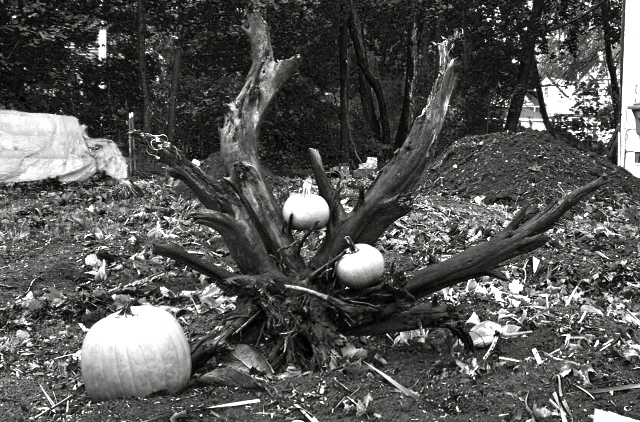
Newest sculpture, home grown
Posted: October 26, 2013 Filed under: Art & Healing, Permaculture & Home Renovation, What is an Art Farm 3 Comments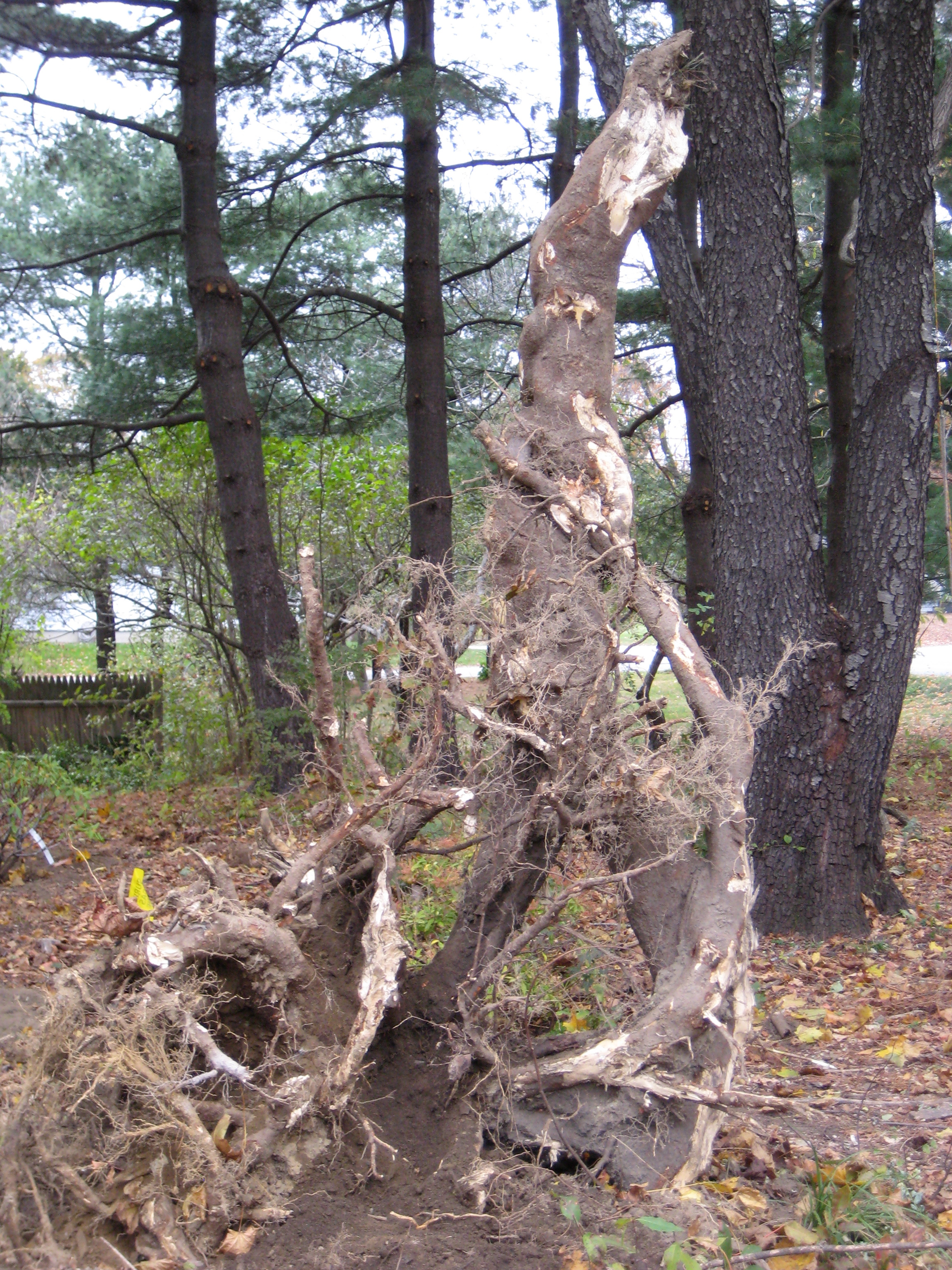
One of the issues in our untended yard is the saplings that took root too close to the house. On the back of our Ell, we had a Box Elder tree growing very close, and we feared its roots could impact the foundation.  Last December we cut down that tree.

The stump remained, and as we prepared to do site work for a new patio, we decided to try to remove it with the excavator.  That root just refused to come out, and the tap root – big as a Christmas Ham – had grown through the foundation into the crawl space beneath the Ell.

We were just about to give up when the root snapped and broke free. The Ell remains standing. Here is a photo of Jim Hamlin, excavator and big game hunter!

We decided that the root deserved a permanent place on our Art Farm. To make it safe, we dug a small hole and set the stump and root upright. It stands more than eight feet tall. Pretty amazing!

Independence…
Posted: July 4, 2013 Filed under: Art & Healing, Farming off the Farm, Gallery - Visual, Permaculture & Home Renovation, What is an Art Farm 4 Comments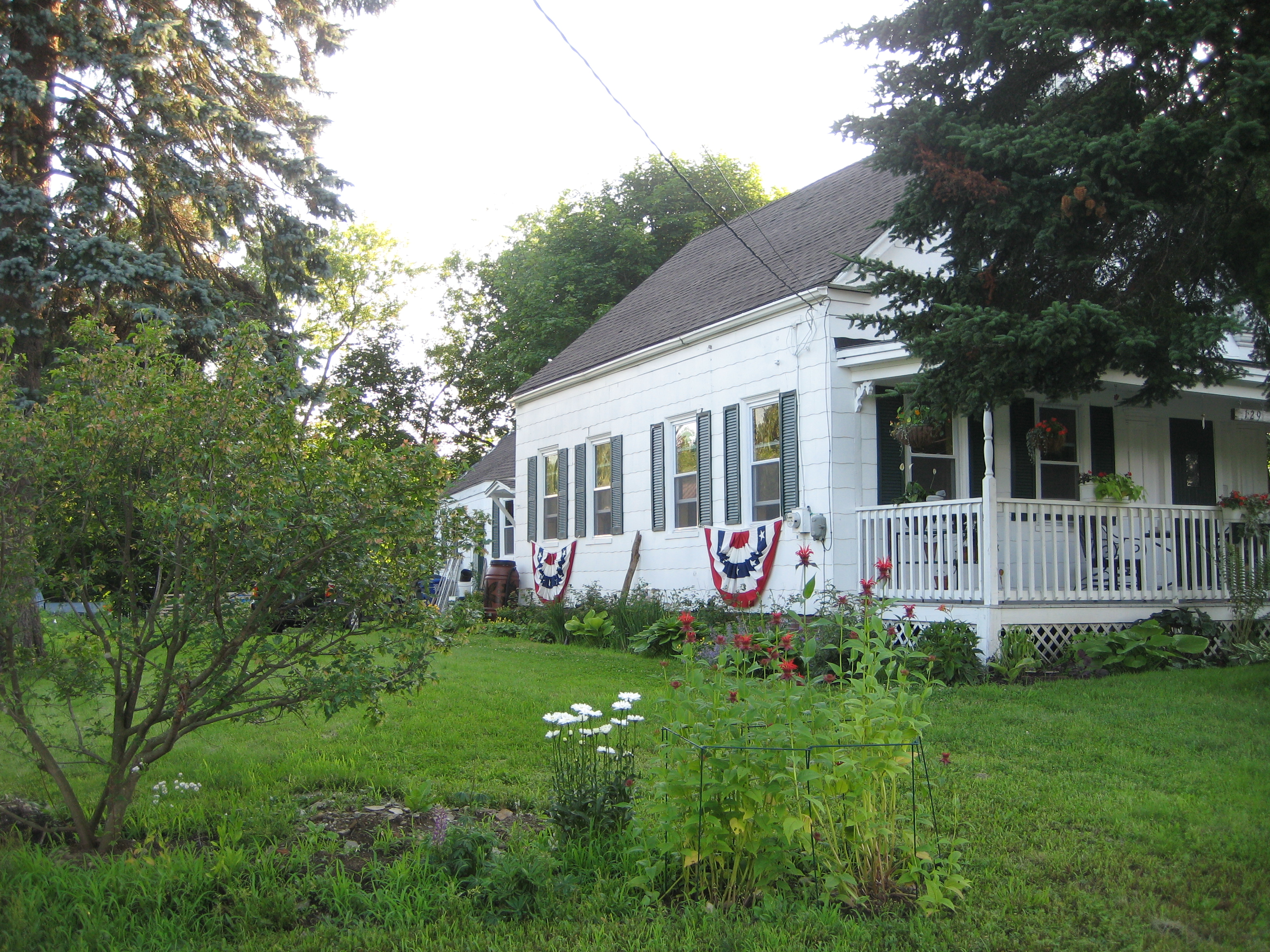
…for us: self sustaining, small footprint, resilience, listening to the land, freedom of choice and teaching our children about consequences, being connected to community, sharing our surplus, growing forward.
Resourceful
Posted: September 19, 2012 Filed under: What is an Art Farm 2 Comments
Something about Maine, perhaps. Tales of derring do, and a “git ‘er done” attitude.
A friend, of Finnish descent, once told of his grandparents, fishermen, who decided to relocate the family from Bangor to Criehaven Island. By row boat. Down the mighty Penobscot River they rowed, by hand, their worldly possessions stowed into that boat, out into the Gulf of Maine some 15 miles.
That pluck abounds today. I am glad to say.
Down at the big house, we are staining the exterior. Glen, the primary painter, lost his driver’s license the other day. I don’t mean he misplaced it, but that his license was impounded. (A long story that, in which Officer Nappi, the local constable on patrol, let him off easy – i.e. did not throw him in jail – after hearing that he was working for us at the big house. Glen was free to go, but he could no longer drive.)
I happened to be driving along and saw Glen, there, stranded. And not too troubled by it all. I returned, riding a fat tired beach bicycle, which I tossed into the back of his pick-up and drove him on to work. The job must go on, and he put in almost a full day’s work.
But, no longer was he able to drive to work. And we have lots of work to be done.
Now, as it turns out, Glen lives across the Saco Bay, and so, he wondered, why not commute to work on his Jet Ski? An easy 8-minute dash (it takes about 40 minutes by auto). I thought it a smashing idea, and now he ties up at the yacht club, and walks straight into the big house yard and climbs up his ladder.
“Like working in paradise,” he says.
The only problem is his ladder remains on his truck, across the bay. But I am sure we can resolve that little issue.
A Cathedral of Trees
Posted: July 12, 2012 Filed under: Art & Healing, What is an Art Farm 4 Comments
In the State of Maine, I am now a Notary Public and authorized to wed beloveds. Notaries are also authorized in Florida and South Carolina, and the latter caught my eye, for an anecdote once I heard.
A man from the low country told me that in South Carolina, when two beloveds stand beneath a Live Oak tree and give voice to their shared love, then that tree is their witness. They are legally wed.
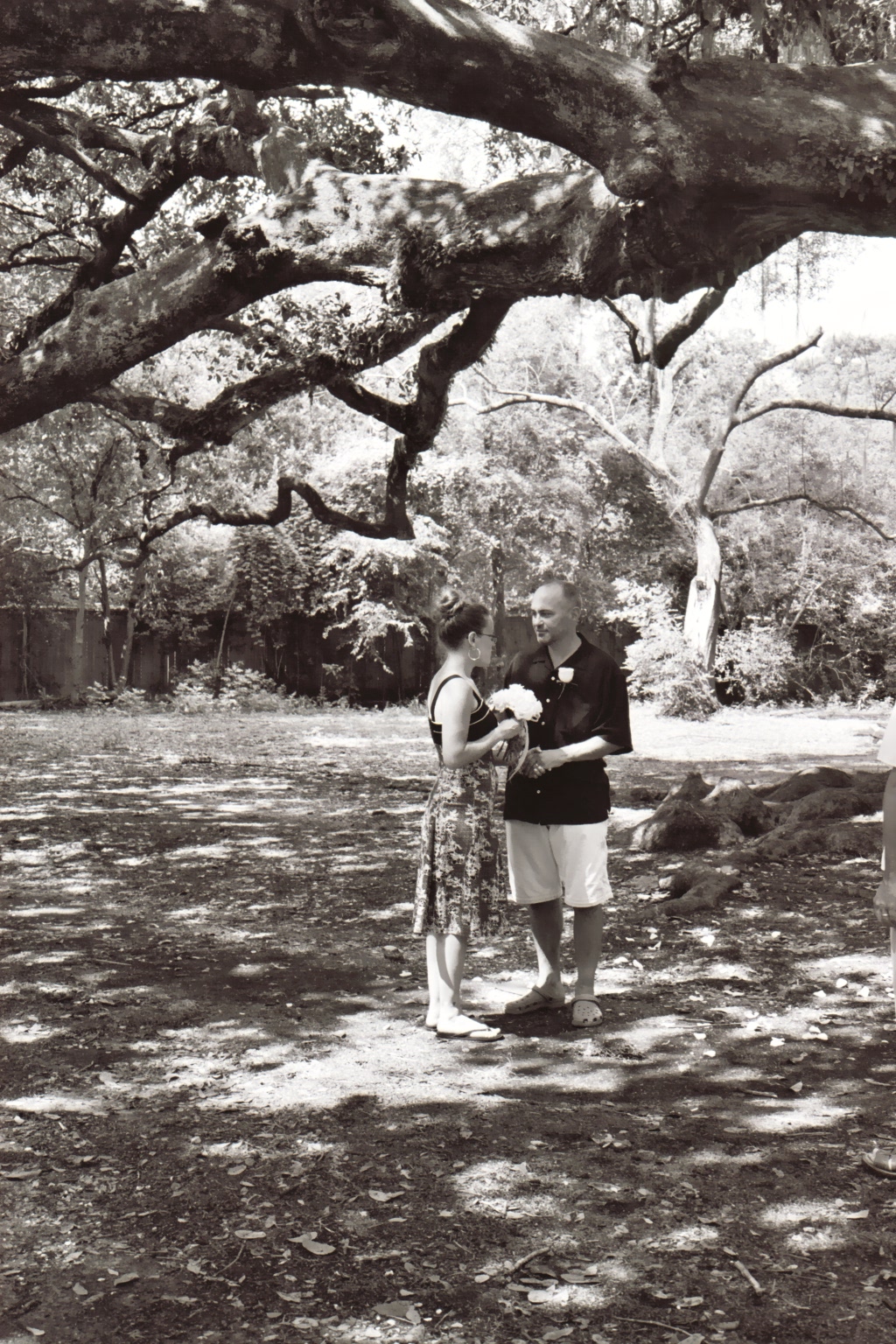
I cannot vouch that law stands, but I can vouch that Quercus virginiana – the southern Live Oak, known to live more than 1,000 years, with a trunk circumference of 40 feet or more, and a crown spread of 90 feet or more – has a powerful draw to couples seeking to give voice to their vows.
The fact is, our blog of June 16, 2011 “Thomas Berry and the Tree of Life” wrote about marriage beneath the live oak tree – that would be my elopement with Becca in August 2004 – and that blog has received the highest number of hits on our Art Farm. Couples have pulled quotations from our text and shown links to our ceremony under the Tree of Life, in Audubon Park in New Orleans. Couples are drawn to that spot, and our experience stands as a marker now along their path.

To be sure, the draw is that tree, more than my prose, and that power is undeniable. To the ancient Greeks, the oak tree was the domain of Zeus, a lightning god and their principal deity. Its rustling leaves, the voice of Zeus.
But more than just elemental power, the oak provides habitat for hundreds of insects and invertebrates, not to mention birds and animals. It is no wonder that the Gauls and Romans associated the tree with the god of agriculture and healing. Healing, perhaps, drew me to the tree.
In Northern New England, Pine trees abound and in Breton legend, that was the tree Merlin climbed, had a revelation and never returned to mortal life; in this sacred tree the soul of Merlin awaits his return. A tree of vitality and continuity, the Pine symbolizes the life force, death and resurrection.
Maine is the Pine Tree state. In colonial days, all Pine trees of a certain girth belonged, by fiat, to the King of England, as masts for the ships of His Majesty’s Navy. But before the English arrived the Indigenous Americans were calling trees, all trees, “our standing brothers,” the quiet center of being.
And if you look around you start to notice that in the ancient wisdom trees were at the center of many traditions: the Tree of Life; the Tree of Knowledge; the “Assembly Tree of the Gods”; the axis mundi of the cosmos; in pre-hieroglyphic script of Egypt, the word for “giving birth” is derived directly from the word for tree. The Tree it seems is the great mother of creation.
They are the yeomen of the oxygen factory but photosynthesis is only one small aspect of their abundance. They gift to us food, clothing and shelter and have informed the architecture of our great spaces. Both Egyptian and Greek temples had columns originally made of trees, later stylized in stone, and from those buildings columns came to adorn places of worship, including banks and government buildings.
It has been argued that the arches and vaults of Gothic cathedrals represent the interlacing branches of trees; the path down the nave becoming a symbolic path among “our standing brothers.” Chartres Cathedral, it has been claimed, was built upon the site of a grove sacred to the Druids.
It is hard to fathom how vast the symbolism may be, and yet easy to understand why lovers are ever drawn, nestled safely among the trees, to give voice to their love.

“Agriculture and Creativity” by Paulo Coelho
Posted: February 15, 2012 Filed under: What is an Art Farm 2 Commentspaulocoelhoblog.com February 11, 2012
Ploughing the field
The moment the soil is turned, oxygen penetrates places it was unable to previously. This process of interior revolution is very important – because, just as the field’s new look will see sunlight for the first time, a new assessment of our values allow us to see life innocently, without ingenuity. A good creator must know how to continually turn over his values, and never be content with that which he/she believes he/she understands.
Sowing
All work is the fruit of contact with life. He/she never knows, at the outset, which things will be important to him in the future, so the more intense his life is, the more possibilities he/she will create for an original language. If he/she tries to imitate or control his inspiration, he/she will never obtain that which he/she desires. He/she must allow his life to sow the fertile soil of his unconscious.
Growth
There is a time in which the work writes itself, freely, at the bottom of the author’s soul – before it dares show itself. The creator must respect the time of gestation, although he/she knows – just like the farmer – that he/she is only partially in control of his field; it is subject to drought and floods. But if he/she knows how to wait, the stronger plants, which can resist bad weather, will come to light with great force.
The Harvest
The moment when a person manifests on a conscious plane he/she sowed and allowed to grow. If he/she harvests early, the fruit is green, if he/she harvests late, the fruit is rotten. Every artist recognizes the arrival of this moment; although some aspects may not have matured fully, some ideas not be crystal clear, they reorganize themselves as the work is produced. Without fear and with great discipline, he/she understands that he/she must work from dawn to dusk, until the work is finished.
Sharing
And what to do with the results of the harvest? Again, we look to Mother Nature: she shares everything with everyone. An artist who wishes to keep his work to himself, is not being fair with that which he/she received from the present moment, nor with the inheritance and teachings of his forefathers. If we leave the grain stored in the granary, it will go bad, even though it was harvested at the right time. When the harvest is over, the time comes to share, without fear or shame, your own soul.
Balance
Posted: December 21, 2011 Filed under: Art & Healing, Chronicles of a First Time Parent, Gallery - Quotes, What is an Art Farm 1 CommentNicole Foss is an author whose focus is the crossroads of peak oil, real politik and global finance; her question is ultimately about sustainability. Writing under the pseudonym “Stoneleigh” she is the Senior Editor at the Automatic Earth [www.theautomaticearth.blogspot.com].
She travelled through Maine recently and I helped organize a presentation in Portland. With less than two weeks notice, we were able to get seventy people to attend on a Monday night. The discussion lasted four hours.
Nicole’s thesis is that the bursting credit bubble will result in a severe retraction of the money supply. By reducing or even eliminating credit, only cash will remain and become extremely scarce, thus reducing the velocity of money; the pendulum will swing away from “the orgy of consumption” toward “austerity on a scale we cannot yet imagine. …As a much larger percentage of the much smaller money supply begins to chase essentials, those [essentials]…will be the least affordable of all.”
This scenario is not, she says, just financial, but compounded by decreasing supplies of oil, with increasing costs of production. “The future is at our doorstep,” she writes, “and it does not look like the past as we have known it.”
No one can know for certain whether Nicole’s scenario will play out. But that provocative message caused us to wonder about what, as a parent, we need to do to prepare our little one for a future so uncertain.
Our response:
Embrace practical skills – planting a garden, baking bread, fixing a flat tire, living within a budget, to name but a few – because they are fundamentally necessary while also teaching self-reliance and help maintain freedom of action.
Live as close to the earth as practical and possible, and build social capital in our community. Personal integrity is the most enduring asset.
Play is essential. Especially in dark times, we need to create joy in our home. Art-making can fit within that, while also teaching resourcefulness and creative problem solving. That is what our art farm is really about.
Everything has its counterbalance. Even amidst dark and dire times, there is hope and light. That is not a pollyanna notion, but something essential; as a balance sheet must have assets to the liabilities, as yin has its yang.
A New England saying is “a rising tide lifts all boats.” But any Yankee fisherman also knows the tide always goes out. The real and natural cycle has both ebb and flow.
Therein lies the balance.
William Coperthwaite: “A Handmade Life”
Posted: July 10, 2011 Filed under: Art & Healing, Gallery - Quotes, What is an Art Farm Leave a comment“I want to live in a society where people are intoxicated with the joy of making things.”
“…the softly focused gaze of Pissarro…”
Posted: July 2, 2011 Filed under: Art & Healing, Farming off the Farm, What is an Art Farm 1 Comment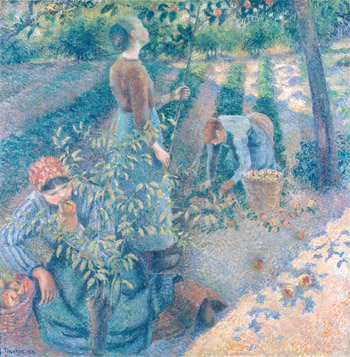
Ananda K. Coomaraswamy: “A Figure of Speech or a Figure of Thought?”
Posted: June 27, 2011 Filed under: Gallery - Quotes, What is an Art Farm Leave a comment“Plato, for example, remarks that ‘the expert, who is intent upon the best when he speaks, will surely not speak at random, but with an end in view; he is just like all those other artists, the painters, builders, ship-wrights, etc.’ and again, ‘the productions of all arts are kinds of poetry, and their craftsmen are all poets,’ in the broad sense of the word. ‘Demiurge’ (demiourgos) and ‘technician’ (technitnes) are the ordinary Greek words for ‘artist’ (artifex), and under these headings Plato includes not only poets, painters, and musicians, but also archers, weavers, embroiderers, potters, carpenters, sculptors, farmers, doctors, hunters, and above all those whose art is government, only making a distinction between creation (demiourgia) and mere labor (cheirourgia), art (techne) and artless industry (atechnos tribe). All these artists, insofar as they are musical and therefore wise and good, and insofar as they are in possession of the art (evtechnos, cf. entheos) and governed by it, are infallible. The primary meaning of the word sophia, ‘wisdom’ is that of ‘skill,’ just as Sanskrit kausalam is ‘skill’ of any kind, whether in making, doing, or knowing.”
 an Art Farm